

Sustainability Report 2025
Published January 2026 · by Dinie van den Heuvel & Julia Gaydina
The year we started measuring
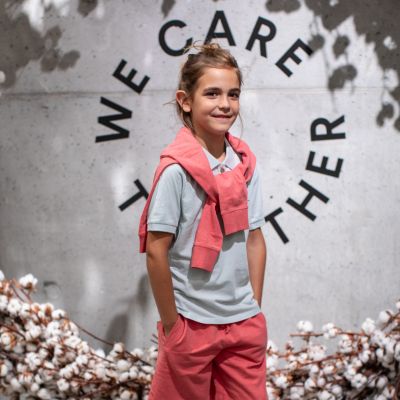
2025 was not an easy year — but it was the year we began the projects we had been building our strength for. We launched our formal B Corp application (preliminary score 96, now in B Lab's evaluation queue — not yet awarded, and we won't use the mark until it is). We joined 1% for the Planet. We evolved from a product business into a brand where knowledge is part of the DNA — a TEDx talk, university collaborations, Pitti Immagine, a zero-waste teaching programme, an educational newsletter. And we built TNTRM, a modest fashion label for girls 8–16, under the same GOTS-certified production standards.
This report shows the plan next to the result, across every corner of the house — including where we fell short. Especially where we fell short.
People — plan vs. reality
Kept: our direct employees earn living wages and work regular hours. Women-led production partners sit at the centre of our chain — Iro Iro (India), Lira Moden (Germany), Genetic Fashion (India) — and our distribution chain is women-led too, end to end. We welcomed four interns, one supported by our India scholarship; began an academic collaboration with Anant University; and started stock-fabric sales that put certified organic cloth into fashion students' hands. Monthly open-day workshops brought our Hannover neighbours into the atelier.
Missed: the deeper wage-gap analysis across our subcontractor network did not happen in 2025. It now leads our 2026 plan, starting with formal salary mapping at Genetic Fashion and Joaquim Gomes Texteis. The body-positivity campaign and representation mapping also carry into 2026.
Planet — plan vs. reality
Kept: 100% of our material inputs were certified organic (76%, with Transaction Certificates), organic-origin (14%, from a facility not itself certified — so those pieces are not labelled organic), or our own recovered cutting waste (10%, rewoven by Iro Iro). No conventional materials entered production. 38% of production used low-waste patterns, up from 10% — we say low-waste, not zero-waste, because cutting waste is reduced, not eliminated. 84% of production was pure mono-material cotton. We recertified under GOTS, confirmed ZDHC MRSL 3.1 chemical compliance, and updated our Environmental Policy to GOTS 7.0. Regular European travel between Hannover and Belgium shifted entirely to rail, saving 3,069 kg of CO₂ as tracked through the Deutsche Bahn app — a structural reduction, not a purchased one.
Corrected: we investigated our old “carbon-neutral shipping” claim, found it was offset-based, and removed it from all consumer communications. (2026 update: parcels now ship via DHL's GoGreen Plus programme — reductions made inside the delivery network, not offsets purchased outside it.)
Missed: inbound fabrics still arrive wrapped in plastic. Eliminating plastic from the inbound supply chain is a 2026 goal.
Product — plan vs. reality
Kept: our first upcycled T-shirt collection, made from pre-consumer cutting scraps. The first Recovered Waste production run with Iro Iro, with all Indian cutting waste now retained on-site for an upcoming capsule. Product pages kept naming materials, suppliers, facilities and production minutes. And a PETA Fashion Award in 2025.
Missed: the formal Preloved expansion on Brandback did not happen as planned — instead, our open-garden events gave 49 garments a second life, proving the demand the programme is built for. Professional repair partnerships were not established; they carry into 2026 with regulatory urgency, as durability and repairability information is due on product pages by September 2026. No Weganool products in 2025 — the Faborg collaboration remains exploratory.
Prosperity — plan vs. reality
Kept: full garment cost breakdowns shared openly with our community. 13 new retail partnerships through our US agent — our largest geographic expansion to date. TNTRM established. 1% for the Planet joined. And a comprehensive audit of every consumer-facing claim against the EU's Empowering Consumers for the Green Transition Directive, with all high-risk items remediated well before the September 2026 deadline.
Missed: the emergency fund was not built — resources went to the TNTRM launch. A formal financial risk assessment leads the 2026 plan.
Certifications, dated
Vegan range verified since 2015 · GOTS since 2019 (Control Union, licence CB-GOTS-CUC-03-1010632) · ZDHC MRSL 3.1 since 2024 · 1% for the Planet member since 2025 · B Corp: in evaluation, target 2026.
Read everything
Perfection may be out of reach; measurement is not. The complete 47-page report — every topic, every target, every miss — is here:
Download the full Sustainability Report 2025 (PDF)
Read the 2024 edition → · Back to Sustainability → · Our circular programme →